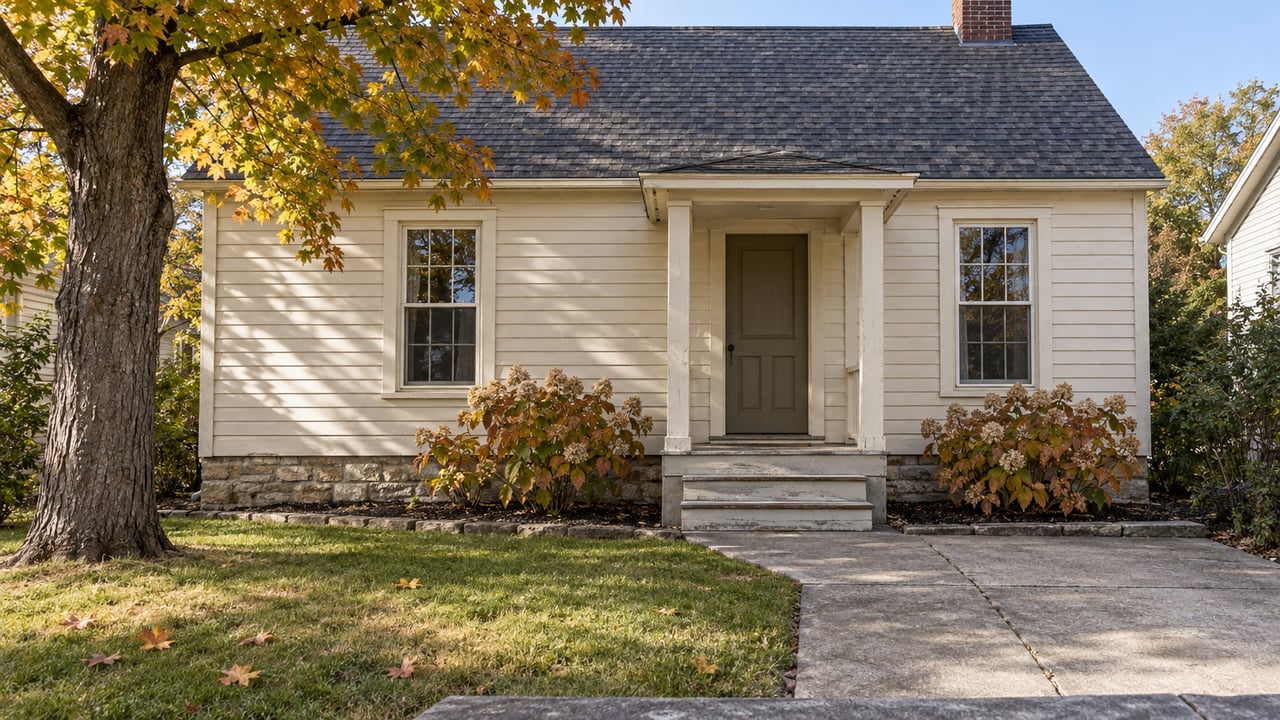
Milwaukee Legalized Backyard Cottages. Why Are the Ones Worth Finding Already a Century Old?
October 15, 2026
October 15, 2026
Milwaukee's accessory dwelling unit ordinance took effect on August 2, 2025. Seven months later, city officials told the Daily Reporter they had fielded inquiries but had received no ADU building-permit applications. That's the most recent Milwaukee count in public reporting. A Milwaukee Business Journal piece from July 2026 described ADU construction across the metro area as still "light."
Meanwhile, the city already has about 1,872 ADU-like structures, most of them built between the 1880s and the 1910s, according to a May 2020 study sponsored by the Department of City Development. If you're comparing neighborhoods because you want a rental unit, room for a parent, or a house-hack setup, the old stock is the market that exists today.
The Common Council passed file 240999 by an 8–7 vote on July 15, 2025. The vote was that close because opponents wanted a special-use permit requirement so neighbors could comment at zoning board hearings. The council voted that down, partly because it would have added application fees for homeowners. So a conforming ADU skips the hearing. It still has to meet a set of standards that shape who can realistically build one. Here's what the Department of City Development's ADU page lays out:
Put together, the occupancy rule and the no-separate-sale rule shut out the two buyers most likely to finance new construction on speculation: an investor who doesn't live on the property, and a builder who would want to sell the back unit on its own. According to the Daily Reporter, DCD said an owner who planned to rent out both a main house and a new unit as short-term rentals would first have to show they lived in the main house to get permission to operate the second unit.
If DNS reviews a detached ADU under its one- and two-family schedule, the city's fee sheet, updated February 2026, is modest compared with what the project itself costs. DNS should confirm which classification applies to any specific project.
| Cost item | What the source says |
|---|---|
| Plan examination | $0.25 per sq ft, $175 minimum |
| Building permit | $0.55 per sq ft, $200 minimum |
| Surcharge and processing | 1.6% surcharge plus a $20 processing fee |
| Plumbing permit | $20 per fixture, $85 minimum, plus 1.6% surcharge and $20 processing |
| Sewer or water extension inspection | $100 per 100 feet or fraction, inspection only |
| Construction of a detached ADU | At least $90,000, per local estimates cited in the 2020 DCD study |
| Rehab of an old 400 sq ft backyard unit in Wauwatosa | Roughly $100,000 to $200,000, per a March 2026 owner estimate |
Sources: the DNS fee schedule, the 2020 DCD-sponsored study, and the Daily Reporter.
On a 600-square-foot detached unit, the plan exam fee would hit its $175 minimum, and the building permit would come to about $330 before the surcharge. That's a rounding error next to a $90,000 floor. The 2020 study also expected internal ADUs and garage conversions to cost more than a detached build.
Financing doesn't close the gap either. DCD says there are no loans made specifically for ADU construction. It points homeowners to cash-out refinances, home equity loans, HELOCs and construction-to-permanent loans. It also notes that the FHA 203(k) rehab mortgage doesn't cover new detached ADUs. All of those tools borrow against equity the owner already has. That points to the same profile the occupancy rule does: an established homeowner who already lives on the lot.
None of this caught the city off guard. The 2020 study predicted "relatively low levels" of new ADUs no matter how the zoning changed. It pointed to Minneapolis, where 92 ADUs were built in the three years after they were allowed. Wauwatosa, which changed its rules in 2019, saw two units built before it started offering forgivable loans.
The study counts 1,872 ADU-like structures, mostly found by flagging parcels with more than one building in the city's property database. It leaves out Polish flats, the raised houses with a partly below-grade lower unit, because the database records them as duplexes. That makes 1,872 an undercount of what a buyer would recognize as two homes on one lot.
The rear houses cluster where the city first filled in. The study maps the heaviest concentrations in Walker's Point on the near south side and in the east-side area around Riverwest, both developed starting in the 1880s. Smaller numbers turn up across the city, including in neighborhoods built later in the 20th century, where they're often garage apartments or additions. The study also names Riverwest and Historic Mitchell Street as areas likely to see new ADU development because of their history with this kind of housing. It describes Historic Mitchell Street as mostly two- and three-story Polish flats.
These older buildings sit under a different legal label than a new ADU. The study says they aren't technically "accessory" units under the zoning code. Rear houses were grandfathered as a second principal structure, and Polish flats as the lower half of a duplex. Their construction "would be difficult or impossible under current regulations," as the study put it in 2020.
That classification is where a transaction gets specific. Three details matter.
Some rear houses come with their own deed. Milwaukee once allowed lots with more than one house to be subdivided. The study estimates about 100 rear houses now sit on their own lots and can be owned separately from the front house. It identified them by an appended "A" on the lot number, such as 123 and 123A on the same street. Under the 2025 ordinance, a newly built ADU can't be split off that way. So a listing with an "A" address is a different kind of property than one that only has a back unit, and the legal description is where that shows up.
The label doesn't settle the use. The study classifies grandfathered rear houses as second principal structures. That's a different category from the ADUs the new occupancy rule addresses. The sources don't say how the city applies its current rules to any particular older structure, though. Before you make an offer that depends on renting the back unit, get DCD to confirm how that specific parcel is classified.
Old units carry new-build costs. The Wauwatosa rehab in the March 2026 Daily Reporter story involved a 400-square-foot backyard house from the 1940s. It needed a new sewer line, a new water main, heating equipment, windows and updated fixtures, and the owners estimated the total at $100,000 to $200,000. A century-old rear house in Milwaukee can raise the same questions. Utility connections and mechanical systems belong near the top of your inspection list. The city's STRONG Homes repair loan, up to $25,000, covers emergency and essential repairs, including collapsed sewer laterals, but it isn't an ADU construction program.
If you were hoping wider reforms would add supply, the 2025 decisions held back on that too. When the council adopted the Housing Element, formerly known as Growing MKE, on July 15, 2025, it dropped the proposal to allow duplexes and triplexes in single-family districts, and the earlier four-unit idea was also removed, Urban Milwaukee reported. The plan is a policy document, and each recommendation needs its own implementation process. The new RT5 district, approved in April 2025, allows buildings of five to eight units, but no property was rezoned automatically. Each parcel needs its own public rezoning approval.
At the state level, Senate Bill 473 would have required communities to allow at least one ADU on residential parcels that have a single-family home. Its official history records it as failed to pass on March 23, 2026.
Can I buy a Milwaukee house and add an ADU to rent out? The ordinance requires at least one owner to live in the main house as their primary residence when the permit application is filed, unless the ADU and a new main house are built together.
Does a detached ADU need its own sewer line? Yes. DCD says each residential structure has to connect directly to a sewer main and a water main.
How do I tell if a rear house is on its own lot? The 2020 study found separately platted rear houses by an "A" added to the lot number, with a matching number on the front lot. Checking the property's legal description and parcel record is the place to start.
If a back house in Walker's Point, Riverwest or anywhere else in the city is part of your plan, Cierra Burmeister can help you sort out whether it's a grandfathered rear house, a separately platted "A" lot or a candidate for a new ADU before you write an offer. If you already own one, ask for a free home valuation that accounts for the second unit.
This article is general information, not legal, tax or financial advice. Consult a qualified professional about your situation.
I believe real estate is more than transactions — it’s about creating experiences that last. Leveraging local knowledge and market insight, I help buyers find homes that truly fit their lifestyle and sellers present their properties with clarity and care. Every client receives personalized guidance, clear communication, and a commitment to excellence. Outside of work, I enjoy exploring Milwaukee’s outdoors, rock climbing, and family adventures.
Cierra Burmeister
1610 N Water St Milwaukee WI 53202